Overview
A hardware illumination system designed and assembled to replicate the varying solar angle experienced by a satellite in a Sun-synchronous low Earth orbit (SSO LEO), developed at the UPC NanoSat Lab. The setup acts as the "sun" inside the lab so that solar-sensor and thermal experiments can be run on the ground with lighting conditions representative of a real orbital pass.
Context
The limitation of a fixed source
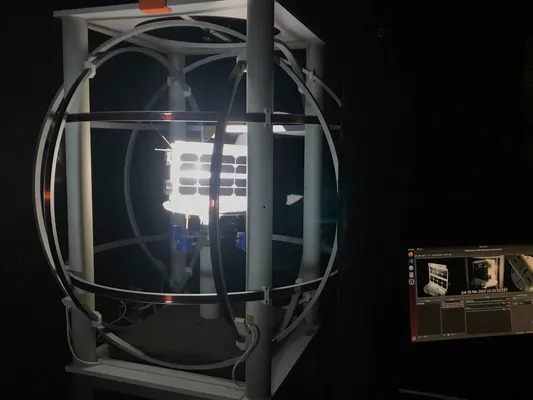
The lab previously relied on a fixed solar cannon, a single collimated light source pointed at the satellite mockup from a static position. While adequate for calibration at a single illumination angle, it could not reproduce the continuous change in solar incidence angle that a satellite experiences as it travels along an SSO LEO orbit, limiting the fidelity of any dynamic solar experiment.
(Credits: Nanoavionics)
What I built
Wooden solar arc
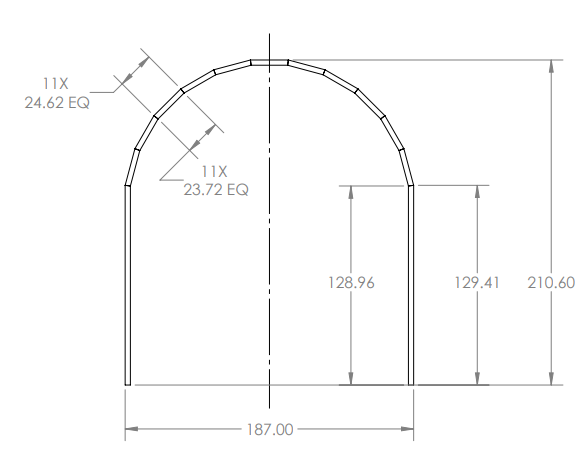
I designed and assembled a wooden arc structure spanning a quarter circle, with seven bulbs evenly distributed along its length. Each bulb illuminates the satellite mockup from a different angle, together covering the range of solar incidence angles that a satellite encounters during an SSO LEO pass. The bulbs are switched individually by a relay module commanded over Ethernet by the ADCS simulation application, so the orbital illumination profile runs in sync with the rest of the testbench without any manual intervention.
Documentation & reproducibility
All wiring, bulb specifications, structural dimensions, and operating procedures were documented so that future students and researchers can reproduce experiments and extend the system without rebuilding institutional knowledge from scratch.
Highlights
- Quarter-arc wooden structure with 7 bulbs to reproduce the solar angle variation of SSO LEO orbits.
- Replaces a fixed solar cannon with a dynamic, multi-angle illumination system.
- Designed to integrate with the lab's existing orbital-simulation testbench (Helmholtz coils).
- Full documentation of structure, wiring, and procedures for long-term reproducibility.